Calculation
of the amount of paving stones Concrete blocks are most often sold in square meters, so it is necessary to accurately measure the area of the planned pavement. Plan a reserve of 5-10% – this will be needed for trimming the blocks.
i
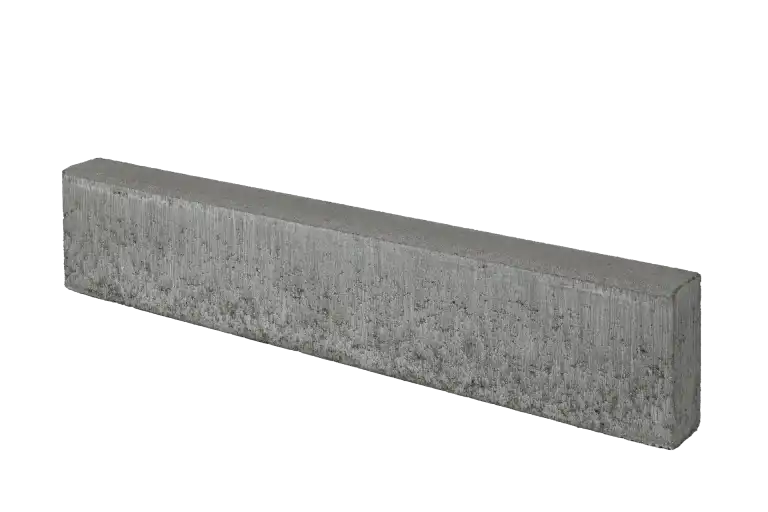
Tip: We recommend reinforcing the edges of the paving with curbs – take measurements according to the exact dimensions of the future pavement.
2
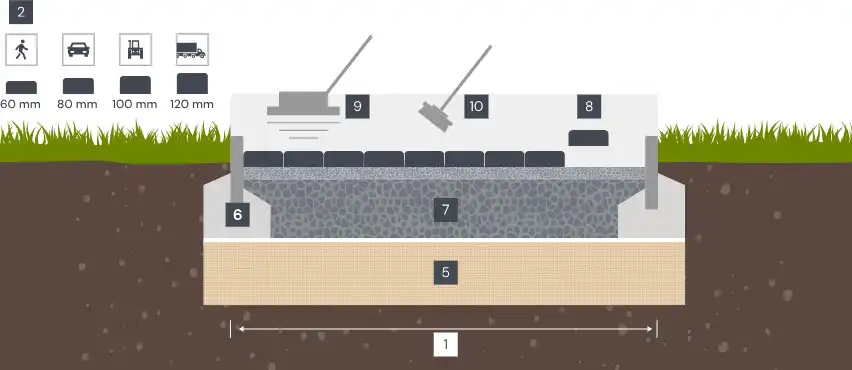
Thickness for purpose
Colour, shape and surface finish are a matter of taste, but the durability of the coating depends on the selection of the right thickness of the blocks:
For sidewalks and courtyards of individual houses: blocks with a thickness of 5-6 cm are sufficient.
For driveways and parking lots: 8-10 cm is recommended.
For industrial areas: 10-12 cm thick blocks.
3
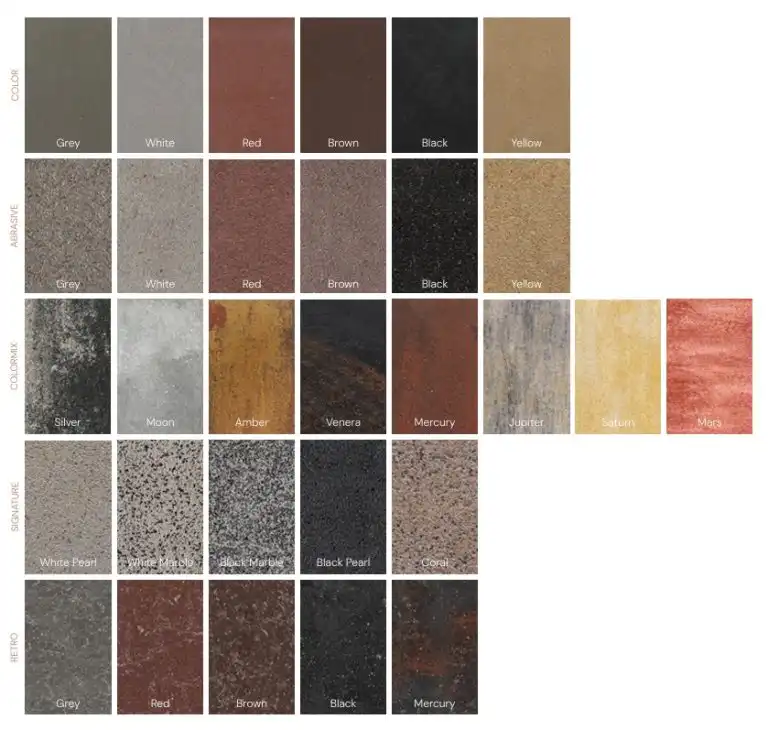
The choice of color and shape Color has a great influence on the appearance of the yard. We recommend combining colors with the façade, roof, fence or other architectural elements of the house.
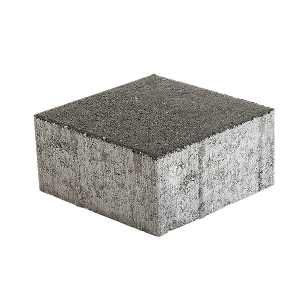
For classic buildings, rectangular or square shapes are suitable.
For modern ones, there are more interesting shapes, for example, hexagonal or triangular.
It is possible to combine blocks of different shapes and sizes, thus creating a unique character of the yard.
4
Preparatory work
Mark the perimeter, check the communications. When removing the top layer of soil, plan the required slope for drainage - about 1-2 cm per meter. Carefully remove the top layer (black earth) 30-80 cm thick according to its intended purpose.
i
Important: Before removing the top layer, anticipate and mark the heights of the future site, taking into account the runoff of rainwater.
5
Preparation of the substrate
Pour a layer of sand of 25-40 cm, level it and compact it. If the soil has a weak load-bearing capacity, lay geotextile between the sand and the soil so that different layers do not mix.
6
Installation
of curbs Install curbs around the perimeter of the future area. This helps to maintain the stability of the pads and prevents them from "slipping away".
7
Formation
of the crushed stone layer Next, a layer of crushed stone is laid, which must be compacted:
In pedestrian zones – at least 10 cm.
For entrances – 20-30 cm.
When finishing the formation of the base, lay a layer of 3-5 cm of fine crushed stone in the upper part - this will ensure a smooth base for laying the blocks. Fine crushed stone also protects the pads from ants.
8
Laying
paving Begin with a straight edge or corner. When laying, use strings to maintain straight lines, place the blocks close to each other.
Recommendation: To ensure that the colour tones do not differ, use pads from at least three different palettes at the same time - this will achieve the natural effect of the shade mixture.
9
Cutting and filling
Measure and cut the pads so that they fit exactly to edges and obstacles. Fill the seams with special quartz sand. Level the surface with a vibrating plate.
i
Tip: The best results are achieved when all seams are checked before cutting and corrected if necessary. Upon completion, the seams are supplemented with quartz sand.
10
Final works
Sweep the surface and complete the filling of the seams. A guarantee of a strong paving coating is not only properly carried out, but also constant maintenance during operation.
11
Learn how to lay pavers in your yard yourself, without professional help! This article provides 10 clear and practical steps to help you successfully complete the project, from the initial planning to the very last paver. The perfect guide for DIY enthusiasts looking to save money and take pride in their own work.
To learn more, contact us:
infolt@brikers.lt
Or call us:
+370 633 52122
www.brikers.lt
We use information collected through cookies and similar technologies to improve your experience on our site, analyse how you use it and for marketing purposes.
We and our partners use information collected through cookies and similar technologies to improve your experience on our site, analyse how you use it and for marketing purposes. Because we respect your right to privacy, you can choose not to allow some types of cookies. However, blocking some types of cookies may impact your experience of the site and the services we are able to offer. In some cases, data obtained from cookies is shared with third parties for analytics or marketing reasons. You can exercise your right to opt-out of that sharing at any time by disabling cookies.